

Introduction
“Never doubt that a small group of thoughtful, committed, citizens can change the world. Indeed, it is the only thing that ever has.”
― Margaret Mead
Here is what a web search has to say about her:
Margaret Mead was a renowned cultural anthropologist known for her insights on culture, education, and social change. Her most cited work emphasizes the power of individual agency and critical thinking. Quotationsbywomen.com
There are various examples of this, such as the American Revolution itself, the Abolitionist Movement, the Women Suffrage Movement, and even the US anti war and anti nuclear movement were all able to make radical changes for the better in US policies.
Many revolutions against oppressive dictatorships, monarchies and so on started with a few people talking to each other. Perhaps the best example is China. In the early 20th Century, China was The Sick Man of Asia, its people in poverty, drug addiction due to the British initiated Opium Wars ruining society.
Following the 1919 May Fourth Movement, communism began to gain traction in China.[8] During 1919 and 1920, reading groups focused on the study of Marxism began to develop in China, with participants who had been involved in political movements of the 1910s like Chen Duxiu and Li Dazhao, as well as younger activists including Mao Zedong.[9]: 23
Here we are barely 100 years following the founding of the Chinese Communist Party, and China has risen from the catastrophe of the Japanese invasions of the 1930’s to China being the undisputed top economy as well having a huge impact on international relations. From Sick Man of Asia, to World Superpower. And it all started with ‘reading groups’.
American Abolishionist Movement
The anti-slavery movement originated during the Age of Enlightenment, focused on ending the transatlantic slave trade. In Colonial America, a few German Quakers issued the 1688 Germantown Quaker Petition Against Slavery, which marked the beginning of the American abolitionist movement. Before the Revolutionary War, evangelical colonists were the primary advocates for the opposition to slavery and the slave trade, doing so on the basis of humanitarian ethics.
https://en.wikipedia.org/wiki/Abolitionism_in_the_United_States
Here is the Crux of the Matter
I have a copy of A People’s History of the United State, however, to save time, I asked the AI engine, Deepseek, to get the core of the matter. Why did the Abolishionist movement fail, despite widespread sentiment to end slavery?
Based on Howard Zinn’s *A People’s History of the United States*, his perspective is that the contradiction between the Declaration’s ideals and the reality of slavery was not a failure of principle, but a calculated decision by a powerful elite to protect their own economic and political interests. In Zinn’s view, the wealthy founders did not believe the principle of equality applied to everyone and actively shaped the nation’s founding documents to serve their own class interests.
### Zinn’s Core Argument: A People’s History “From the Bottom Up”
Zinn’s approach is to tell American history from the perspective of the oppressed—the enslaved, Native Americans, and the working poor. He argues that the nation’s history is a story of class conflict, where a powerful elite consistently used rhetoric about liberty and equality as a tool to maintain control over the lower classes. From this viewpoint, the founding of the United States was not a noble pursuit of universal freedom, but a project by wealthy men to secure their own power and wealth.
### How Zinn Explains the Contradiction Between Ideals and Reality
Zinn addresses your question about the dictum “All Men Are Created Equal” by arguing that it was never meant to be universal. For the founders, according to Zinn, this phrase was a tool to unify the colonists against Britain, not a promise to Black people, women, or the poor. He argued that colonial society was dominated by wealthy white men “who had enough money to make others work for them,” and that the nation’s core principles were designed to benefit this specific group.
In his view, the government’s support of slavery was a matter of **practicality and profit** for the elite, not a philosophical contradiction they struggled with. The institution was a deeply entrenched system of capitalist enrichment, and the ruling class was unwilling to sacrifice their immense wealth—described as “a thousand millions of dollars in the value of [their] slaves, and a thousand millions of dollars more in the depreciation of [their] lands”.
### The Role of Wealthy Interests and Opposition
Zinn did not ignore opposition to slavery. He documented slave rebellions, such as those led by Prosser, Vesey, and Turner, and the actions of white abolitionists like John Brown. However, he argued that the government’s response was always calculated. The state was passive in the face of moral opposition and only acted when it became profitable or politically safe to do so. For example, he suggests that Abraham Lincoln’s emancipation was a strategic decision orchestrated by the government to limit the scope of freedom and ensure a reconstruction that was “safe” and “profitable,” rather than truly radical.
Bingo!
Ultimately, Zinn’s analysis frames the persistence of slavery as a direct result of the nation’s founders prioritizing their own economic and political dominance over the nation’s stated ideals. The desire to maintain wealth and control, in his view, was the true core principle that guided the country’s early leaders.
Roosevelt’s Efforts to Correct Mass Poverty and Inequality Nearly Sabotaged
The Business Plot: A Clear Case of a Fifth Column
The Business Plot, also called the Wall Street Putsch[1], was a political conspiracy in 1933 in the United States to overthrow the government of President Franklin D. Roosevelt and install Smedley Butler as dictator.[2][3] Butler, a retired Marine Corps major general, testified under oath that wealthy businessmen were plotting to create a fascist veterans' organization with him as its leader and use it in a coup d'état to overthrow Roosevelt. In 1934, Butler testified under oath before the United States House of Representatives Special Committee on Un-American Activities (the "McCormack–Dickstein Committee") on these revelations.[4] Although no one was prosecuted, the congressional committee final report said, "there is no question that these attempts were discussed, were planned, and might have been placed in execution when and if the financial backers deemed it expedient."
The Two Takeaways from This Case Study
Just like Orwell said in Animal Farm, all men are created equal but some are more equal than others
A small group of determined (and I would say unscrupulous) people wrote the Constitution for their benefit, not ours! One could argue that they’re succeeding! The last two Presidents were Joe Biden “The Senator from Mastercard”, and Donald Trump. Both eager supporters of genocide in Palestine and war on Russia.
Flash Forward to Today: The Case of Dimitri Lascaris and His Former Law Partner
We were sitting down having dinner and right across from me was McKinnon and Isizinga [Two politicians of the “Liberal Party”, the one that promises and always breaks them] and one of them looked over at me as we were having dinner and said to me, “Hey Dimmitri, uh, I can’t understand why you are involved with the Green Party.” And I found this question to be quite curious because I expected that it would be obvious why I was involved with the Green Party. But I responded immediately and honestly as follows.
As I said, the reason I’m with with with the Green Party is because of all the parties that are in Canada’s parliament, it is the one whose core values most closely align with my own. I may not agree with everything the Green Party doesn’t says, but uh it is the one that I feel most comfortable with from the perspective of principle.
And at that point, they kind of looked at each other, looked at me, thought my answer was kind of bizarre that judging from their expressions. And hen I decided to ask them. I said, “Why are you so active in and committed to the Liberal Party?” And without, you know, blinking an eye, they both gave the same answer. And the answer was because we win. That was their answer.
Had nothing to do with values, had nothing to do with principles. It was all about power. And they made absolutely no bones about the fact that it was all about power. They didn’t feel even remotely ashamed as far as I could tell uh to answer my question in that way. And that pretty much defines who the liberals are, especially the power brokers in the Liberal Party.
These people don’t give a rat’s ass about human rights, about genocide, about racism, about conquest, about violations of the United Nations Charter, about equality, about compassion, about human decency. All they care about is power.
And frankly, they’re pretty damn good at acquiring it in our compromised uh political and economic system.
Now Let’s Turn to Project Ukraine
For those of you who don’t know, the CIA empowered for many years, Ukrainian Nationalist collaborators of Germany after they lost WWII. Many escaped to the USA and Canada. These were the people—a minority- who committed serious atrocities against Poles, Jews, Russians and other Ukrainians, before being driven underground, imprisoned or escaped.
After years, their descendents resurfaced in 2014, and with US backing overthrew the democratically elected President Yanukovych. What ensued was an 8 year smouldering civil war. Eventually, having increased shelling of breakaway areas in Eastern Ukraine from 40 to 1000 or more per day, Russia preempted what was sure to be a mass murder and ethnic cleansing of Donetsk and Lugansk.
This is another example of a small minority of extremists having a big—and highly negative effect-on a whole country.
“Why Is It Taking So Long?”
Many of us thought that the war would be over in a few weeks. It’s now 4 1/2 years, and it’s still going on. So what happened?
A couple of years ago, I asked a Russian friend in Moscow, why the war didn’t end soon. His opinion is that wealthy interests—both Russian and Ukrainian— don’t want the war to end because they profit from it. As Lindsey Graham said, killing Russians and fighting to the last Ukrainian made him very happy [and rich—].
Here is what one Russian military expert says:
In general, it should be noted that capitalism as a social system generates a genetically fifth column in any country. And in Russia in particular, given the special size, given the population, mentality and everything else.
Therefore, one of the reasons why capitalism has always led to a national catastrophe in Russia but the February revolution of the 1917 is a national catastrophe, right? And it was the October Revolution that was the national salvation.
This was well raised by thinking officers of the imperial army who came to serve in Red Army. Today we see this with our own eyes. Uh-huh. What happened to Russia was left in February, 1991, that Russia received, and what remains of it, what we are now trying to restore and in what ways we are restoring. And we restore, again, through mobilization, through government agencies. This is a fundamental question.
Therefore, the answer is unambiguous, which you ask, of course, without switching the rails of socialism, well, someone doesn’t like the purely word socialism, I’ll change this matter to the rails of military socialism.
In other words, Russia has socialized the military industrial complex, making it able to produce far more materiel than the privatized US and Europe—combined.
How’s It Going in the USA?
The twin killers of the US economy are Privatization and Militarization
These Russians argue that state coordination is necessary to fight a war. So how does the USA stack up on winning wars with a privatized military? In short, from the ‘stalemate’ in Korea, to Vietnam, Afghanistan, Iraq, the US has lost most of its wars, even against 3rd world countries, or countries with far smaller militaries.
It has been able to capture Venezuela, and it won its wars against Yugoslavia, Libya, Grenada.
Here’s what it’s looking like for next year:
https://legis1.com/news/fy2027-ndaa-defense-budget-proposes-114-trillion
The Bottom Line
Congress has not yet enacted the FY2027 NDAA as of the report’s publication on July 24, 2026, but the trajectory is clear: defense authorization levels will exceed $1.14 trillion, with the administration pushing for an additional $350 billion in mandatory spending. The House and Senate have largely aligned on the top-line figure while disagreeing on specific allocations, most notably on military construction.
So, it’s not really $1.14 trillion, it’s that PLUS the additional $350 billion. Compare that with China’s and Russia’s military budgets:
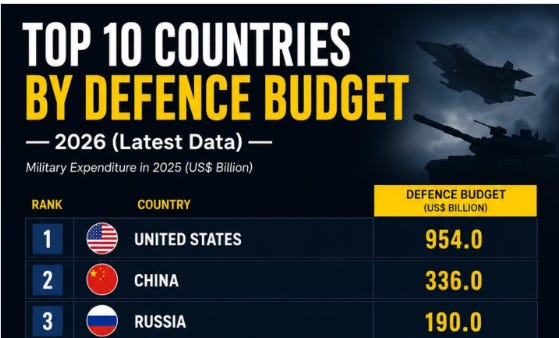
Yet, we’re having a hard time defeating Iran, whose military budget is far less!
Iran military spending in 2026.
Iran’s officially reported 2025 defense spending was $7.4B per SIPRI (a 5.6% real-terms decline, the second consecutive annual fall), but actual military expenditure is widely believed to be 2-3x larger once IRGC, nuclear program, and proxy support are included.
So the US military budget as of 2026 will be about $954 billion, compared with a maximum estimate of Iran’s 3x $7.4 billion, or $22.2. That 43x more than Iran spends.
Not exactly a model of Free Market efficiency!
The Real Costs of War
https://costsofwar.watson.brown.edu/costs/economic/us-federal-budget
Key Findings
U.S. Federal Spending
In the two years since the October 7, 2023 Hamas attack on Israel, the U.S. government has spent $21.7 billion on military aid to Israel. The U.S. has spent an additional $9.65 – $12.07 billion on military operations in Yemen and the wider region since October 7, 2023, for a total of $31.35 – $33.77 billion and counting in U.S. spending on the post-10/7 wars.
H.R. 1 provides $156 billion for Pentagon and military-related programs in fiscal years 2025 - 2029. In fiscal year 2026, it increases Pentagon and military-related spending by over 13 percent from FY25, pushing ‘national defense’ spending beyond the $1 trillion mark.
U.S. military spending produces an average of five jobs per $1 million in spending, including both direct jobs and jobs in the private industry supply chain. In contrast, 13 jobs are created for every $1 million in education spending – nearly three times as much employment.
Between 2020 and 2024, $771 billion in Pentagon contracts went to just five firms: Lockheed Martin ($313 billion), RTX (formerly Raytheon, $145 billion), Boeing ($115 billion), General Dynamics ($116 billion), and Northrop Grumman ($81 billion). In comparison, the total diplomacy, development, and humanitarian aid budget, excluding military aid, was $356 billion.
The U.S. spends over twice as much as China in military spending, even after accounting for differences in labor costs and purchasing power.
While the Russian military maintains the world’s largest stockpile of nuclear weaponry, the Russian defense budget amounts to less than 1/10 of the U.S. defense budget. Western strategists have a long tradition of over-inflating Russia as a military threat.
Spending on the Post-9/11 Wars
From late 2001 through fiscal year 2022, the U.S. appropriated and is obligated to spend an estimated $8 trillion for the post-9/11 wars — an estimated $5.8 trillion in appropriations, plus an additional minimum of $2.2 trillion for obligations to care for the veterans of these wars through the next several decades.
Of the $8 trillion total, about $2.3 trillion were spent on the budget category for post-9/11 military operations, “Overseas Contingency Operations.” Over $1 trillion has already been spent on interest payments, since these operations have been funded entirely through debt. The base budget of the Pentagon has increased by about $900 billion above what it would have been in the absence of war; Homeland Security spending on preventing and countering terrorism within the U.S. has totaled over $1.1 trillion since the inception of the Department of Homeland Security in 2002; and current and future costs for veterans has added nearly $2.2 trillion and that figure will continue to grow.
From 2001 to 2019, the U.S. spent over $2 trillion on the war in Afghanistan.
In the 20 years of war from 2003 to 2023, the U.S. spent and obligated over $2.89 trillion on the wars in Iraq and Syria ($1.79 trillion spent through 2023, plus $1.1 trillion in obligations for future veterans’ care).
These federal expenditures and obligations do not include many other types of budgetary costs, including state and local government spending, private costs, future interest payments, or opportunity costs. Nor do they include costs to foreign governments or economies.
Western allies of the United States bore significant costs in the post-9/11 wars, in terms of both dollars and lives. When measured as a percentage of their annual baseline military expenditures, the United Kingdom and Canada spent roughly half as much on Afghanistan as the United States. And when measured in terms relative to their respective Gross Domestic Products (GDPs), the U.S. provided less foreign aid than did the U.K., and about the same amount as Germany and Canada.
Future U.S. Spending
As veterans continue to bear huge physical and mental costs from the post-9/11 wars, the costs of caring for these veterans will reach between $2.2 and $2.5 trillion by 2050 – most of which has not yet been paid. The U.S. risks shortchanging its promises to these veterans if the government does not make adequate budgetary commitments.
The costs associated with caring for veterans do not reach their peak until decades after the wars they fought, as veterans’ needs increase with age. Expenditures to care for veterans doubled from 2.4 percent of the total federal budget in FY 2001 to 4.9 percent in FY 2020, even as the total number of living veterans from all U.S. wars declined from 25.3 million to 18.5 million.
The post 9/11 wars were “credit card wars.” By 2030, the U.S. will have spent as much on interest payments as it did on “overseas contingency operations” for the wars themselves – over $2 trillion.
And what about Privatization? How’s that working out for we the people?
Effects of Privatization
Handing public assets and services over to the free market has been a boon for corporate America and a disaster for the working class.
And when it comes to saving money, the evidence is mixed at best. In many cases, privatization turns out to be far more costly. A 2007 survey found that over half of the local governments that placed services back under public control did so because privatization didn’t cut costs. After Iowa hired insurance corporations to manage its Medicaid program in 2017, the average cost of insuring people climbed nearly three times as fast as when it was under public control. An Indiana toll-road built using private financing — known as a “public-private partnership” — launched in 2014 by then-Gov. Mike Pence turned out to be $137.3 million more expensive than if the state had used traditional public financing. Charter schools, which are publicly funded but privately operated, are costing San Diego’s school district $65.9 million a year. And then there’s healthcare, an area where the United States spends twice as much as other countries thanks to a “free market” of private doctors, nurses, hospitals and drugs.
Conclusion
While it is certainly true that small groups of people committed to helping their people, the countries, and the planet can do a lot of good, the reality is that a small group of people who in most cases control or at least influence public policy grossly distort a society, resulting in long term failure.
Class war is a real thing. And in the case of the US and Europe, which has had its hayday mainly by theft of other societies’ wealth, through conquest, slavery, or colonialism, in the long run, wealthy elites’ greed and selfishness end up weakening their society. The parasites weaken their unwilling or unaware hosts—you and me—, resulting in their own demise unless they can find new victims.
Times have changed, and they probably won’t get away with it. Which is why they are so desperate.


